
TL;DR
- Lifecycle marketing is the practice of engaging each customer according to the stage of their relationship with your brand, and adapting the message, offer and channel as that stage changes.
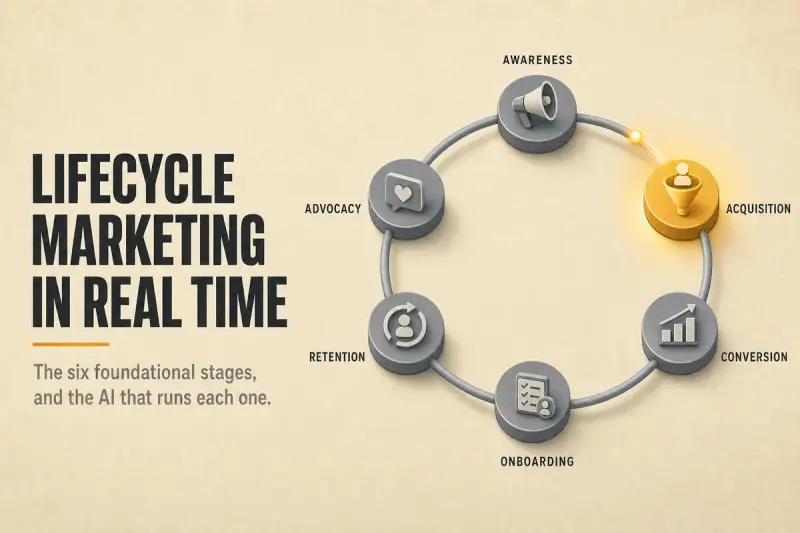
- Most models use six stages: awareness, acquisition and consideration, conversion, onboarding and activation, retention and engagement, loyalty and advocacy. Reactivation loops lapsed customers back in.
- A lifecycle marketing strategy comes down to five steps: map real stages, unify the signal, define the next best action per stage, automate the plays, then measure stage velocity against a holdout group.
- Lifecycle marketing automation used to mean scheduled drips. AI agents now read each customer's stage from live conversations and act on it in seconds.
Priya runs growth at a company that does everything right. The leads flow. The dashboards fill. And still, the same customers slip away in the quiet space between the welcome email and the second purchase.
Lifecycle marketing is the discipline that closes that gap. It is the practice of engaging each customer according to where they are in their relationship with your brand, and adapting every message, offer, and handoff as that relationship changes. Each stage carries its own intent, and each intent asks for its own next move.
Awareness. Purchase. Retention. Advocacy.
That is the textbook answer. The textbook is now out of date.
For a decade, lifecycle marketing meant a calendar of campaigns bolted to a funnel. You mapped the stages, wrote an email for each one, and hoped people moved in a straight line. They never did. This guide is the definitive version for how the practice actually works now: the foundational stages every brand still needs, and the AI execution layer that finally makes those stages move in real time. Read it as the map. The rest of our lifecycle library is the territory.
What Is Lifecycle Marketing, Really?
Most people confuse three things that sit next to each other. A customer journey is the path a person actually walks. Customer lifecycle management is the operational system of record that tracks their status. Lifecycle marketing is the deliberate act of shaping that journey with the right intervention at the right moment.
Here is the cleaner cut. The journey describes what happened. Lifecycle marketing decides what happens next.
As a process, lifecycle marketing repeats four moves for every customer: read the stage they are in, choose the next action that moves them forward, deliver it on the channel they actually use, and measure whether they moved. The stages give the map. The four moves are the work.
If you want the ground-level primer on the concept itself, we cover what lifecycle marketing is and why it is reshaping customer journeys in a separate explainer. This guide goes further. It maps the full stage-by-stage system, and the AI that now runs each stage.
The reason the discipline matters more every year is simple economics. Fred Reichheld's research at Bain and Company found that increasing customer retention by five percent can lift profits by anywhere from 25 to 95 percent. Acquisition gets the headlines. The lifecycle is where the margin lives. And customers now expect the whole relationship to feel considered, with McKinsey reporting that 71 percent of consumers expect personalized interactions and get frustrated when they do not arrive.
So lifecycle marketing is a coordination problem before it is anything else. And coordination is exactly where most teams quietly lose.
Map the whole relationship before you write a single campaign.
Lifecycle Marketing vs Marketing Lifecycle vs Engagement Lifecycle
Three phrases get searched as if they mean the same thing. They describe different objects, and mixing them up is how teams end up optimizing the wrong one.
| Term | What it describes | Question it answers |
|---|---|---|
| Lifecycle marketing | The practice of engaging each customer by relationship stage, from awareness to advocacy | What should this customer get next? |
| Marketing lifecycle | The life of a single campaign: brief, strategy, execution, measurement, learning | How do we run this campaign well? |
| Engagement lifecycle | How active and responsive a customer is over time, from new to engaged to dormant to lapsed | Is this customer leaning in or drifting away? |
| Customer lifecycle management | The system of record that tracks each customer's status | Where does this customer officially stand? |
| Customer journey | The path a person actually walked across touchpoints | What happened, and in what order? |
The marketing lifecycle is about your campaigns. The engagement lifecycle is a reading of the customer's energy. Lifecycle marketing uses that reading to decide the next move, which is why the engagement signal is the most valuable input a lifecycle program has.
Lifecycle marketing is organized around the customer's relationship. The marketing lifecycle is organized around your campaign calendar.
The Six Stages of the Customer Lifecycle
Every durable lifecycle marketing model rests on the same spine. Names vary. The underlying stages hold steady. Here is the version we use, from first spark to loyal advocate, with the job each stage actually performs. For the older funnel view of the same stages, see our customer lifecycle blueprint.
Stage 1: Awareness
A stranger meets a problem, and your brand enters the frame as a possible answer. The job here is reach with relevance. You are not selling yet. You are earning the right to be remembered when the need sharpens.
Stage 2: Acquisition and Consideration
Interest becomes evaluation. The prospect compares, questions, and quietly decides whether you are worth the risk. This is where most first-party signal appears: a demo request, a pricing page visit, a message that starts with "does it work with our stack." Capture the intent, or watch it cool.
Stage 3: Conversion
The moment of commitment. A lead becomes a customer and hands you money and trust in the same breath. Legacy funnels treated conversion as the finish line. In practice it is the handoff between two entirely different relationships.
Stage 4: Onboarding and Activation
The most underrated stage in the entire lifecycle. A customer who never reaches first value is a refund waiting to be requested. Activation is the difference between a purchase and a habit. Get someone to their "aha" fast, and every later stage gets easier.
A working activation flow in lifecycle marketing has three beats:
- Name the first win. The welcome message tells the customer the one thing to do first and why it matters.
- Check that it happened. Watch product events and conversations for proof the customer reached that first value.
- Unstick the stalls. When the check fails, send a targeted nudge or answer the blocking question live, on the channel the customer used.
The check is the beat most flows skip. Without it, onboarding is a timer.
Stage 5: Retention and Engagement
The long middle where revenue compounds or leaks. Retention is quiet work: the timely nudge, the relevant tip, the renewal that feels like a reminder instead of a demand. This is the stage the spreadsheet forgets and the profit line never does.
Stage 6: Loyalty and Advocacy
A retained customer keeps buying. A loyal one brings friends. Advocacy turns your best customers into a distribution channel, and it only happens when the earlier stages felt genuinely good. You cannot shortcut your way here. You can only earn it.
Notice what is missing from that list: an exit. The best programs treat lapsed and at-risk customers as a loop back into the lifecycle. Reactivation is a stage too. It just runs in reverse.
Lifecycle Marketing Strategies by Stage
Each stage has a small set of plays that do most of the work. Pair every play with the signal that tells you it is time to run it.
| Stage | Strategy that works | Signal to watch |
|---|---|---|
| Awareness | Useful content matched to the problem a person searched for | Topic and source of the first visit |
| Acquisition and consideration | Live answers to objections, comparison help, fast demo booking | Pricing page visits, integration questions, competitor mentions |
| Conversion | A clear next step and a handoff that carries the full conversation | Buying-committee questions, procurement or security asks |
| Onboarding and activation | A first-win activation flow with checks | Time to first value, setup errors, support questions |
| Retention and engagement | Usage tips timed to behavior, early save plays for at-risk accounts | Falling usage, unresolved tickets, sentiment turning negative |
| Loyalty and advocacy | Referral and review asks timed to a moment of delight | Praise in conversations, expansion, repeat purchases |
| Reactivation | A win-back offer tied to the reason the customer left | Lapse date plus the last thing they said |
Know every stage before you automate one.
Why Does Traditional Lifecycle Marketing Stall?
Meet the way it usually gets built. A marketer maps six stages on a whiteboard. Then they open their email tool and build six batches. Awareness batch. Onboarding batch. Win-back batch.
Each one fires on a fixed trigger, at a fixed time, to a segment that was accurate the day it was defined and slowly rots after.
Call it the Batch-and-Blast Trap. It looks like lifecycle marketing. It behaves like a broadcast schedule.
Take Rohan, a new customer three weeks in. He messaged support twice about an import that kept failing, gave up, and stopped logging in. On the same Tuesday, his onboarding sequence cheerfully sent tip number four: "Ready to invite your team?" The system saw a timestamp on a drip. It could not see a man who had already decided to leave.
The problem is that real customers refuse to march in formation. Someone lands in your onboarding sequence while they are already frustrated enough to churn. Someone else gets a "we miss you" campaign the day after they bought again. The stages are real. The system's read on which stage a person occupies is stale, thin, and click-first.
Consider the gap:
The Old Way: A user opens two emails and clicks one link, so the tool marks them "engaged" and moves them forward.
What actually happened: That same user asked a question on WhatsApp, got no answer, and is now comparing you to a competitor.
The clicks said engaged. The conversation said leaving. Legacy lifecycle tools cannot see the second signal, because they were built to track events, and meaning was never in scope. This is the ceiling every team hits, and it is why so many teams start asking whether their lifecycle marketing tools have quietly become the bottleneck.
Stop guessing the stage. Start reading it.
What Is Lifecycle Marketing Automation?
Lifecycle marketing automation is software that runs lifecycle plays without a marketer sending each one by hand. It decides when a customer enters a stage, which message or action fits, and which channel delivers it.
For most of the last decade that meant rules: if a contact signs up, start the welcome drip, and if they go quiet for 30 days, send the win-back email. Rules are predictable and easy to audit. They also break the moment a customer behaves in a way the rule did not foresee, which is most of the time.
AI changes what can be automated. Here is how much of lifecycle marketing an AI system can run today, and what the team still sets once:
- Automated by AI agents: reading each customer's stage from behavior and conversation, choosing the next best action, timing it, picking the channel, answering routine questions, following up, and logging every outcome back to the CRM.
- Set once by the team: the goal for each stage, the offers and content the agents may use, brand and compliance boundaries, and the rules for which threads route to a rep.
- Reviewed on a cadence: stage velocity, holdout results and the plays that stopped working.
That split is the practical difference between a drip tool and an orchestration layer, covered in depth in journey orchestration vs marketing automation. Mobile-first teams weighing push and in-app platforms for the same job can start with our CleverTap alternatives comparison.
Automate the decision about the next step for each customer. A schedule only automates the send.
How Does AI Execute Across Every Stage?
This is the shift the last decade was waiting for. For years, the stages were a strategy you drew and a machine you could not build. Agentic AI is the machine. It reads intent in real time, decides the next best action for each person, and executes across channels without waiting for a marketer to schedule a send.
Speed matters, and the bigger change is the unit of decision. A batch tool asks "what campaign is this segment in." An agentic system asks "what does this specific person need right now, given everything they have ever said to us." That question is only answerable if the system holds context. At Zigment, that context lives in the Conversation Graph, a temporal record of every identity, intent, and sentiment across every channel, so an agent knows the full story before it acts.
And it acts while intent is still warm. Agents respond in seconds across chat, WhatsApp, email and social, inside boundaries the team configures once. High-value and high-risk threads route to a rep with the full conversation attached.
Here is what execution looks like when it stops running on a calendar and starts running on intent.
| Stage | Batch-and-blast execution | Agentic execution |
|---|---|---|
| Awareness | One creative to a broad list | Message shaped to the intent a person just expressed |
| Consideration | Generic nurture drip | Live answers to the exact objection raised in chat |
| Onboarding | Day-1, Day-3, Day-7 emails | Nudges paced to whether the customer actually reached first value |
| Retention | Monthly newsletter to all | An intervention the moment sentiment turns at-risk |
| Advocacy | Quarterly referral blast | An ask timed to a customer's genuine moment of delight |
A lifecycle stage is a state of mind, and it can change mid-conversation.
See the shift? The left column treats a stage as a time slot. The right column treats a stage as a state of mind that can change mid-conversation. When an agent detects that a happy renewal has turned into a support complaint, it does not wait for next month's segment refresh. It re-plans on the spot, because the stages are no longer sequential boxes. They become adaptive states the customer can enter, skip, or regress through.
This is also where the tired debate about email dies. Email still works. Batch email is what stopped working. When a send is informed by what a customer actually said, lifecycle email becomes a response instead of a broadcast, and it starts converting like one.
Orchestrate the decision, and the message follows.
How Do You Measure Lifecycle Marketing?
Most lifecycle dashboards measure motion and call it progress. Opens. Clicks. Sends.
Vanity metrics that move whether or not a single dollar does. A serious program measures the health of each stage and the flow between them.
Anchor your measurement to the stage, not the channel:
- Awareness: qualified reach and net-new intent captured, not impressions.
- Acquisition: lead-to-opportunity rate and time to first meaningful response.
- Conversion: win rate and speed from intent signal to closed revenue.
- Onboarding: activation rate and time to first value, one of the earliest signals of retention.
- Retention: net revenue retention and at-risk accounts caught before they churn.
- Advocacy: referral-sourced pipeline and repeat-purchase rate.
The metric that ties them together is stage velocity: how fast, and how profitably, a customer moves from one stage to the next. Legacy attribution cannot compute it, because it never had a continuous record of the customer to measure against. An orchestration layer does. It watches the whole timeline, so it can tell you which conversation actually drove the outcome, and detect churn risk from the tone of a conversation long before the cancellation form loads.
Prove the lift with a holdout. Keep a small, random control group out of each lifecycle program, then compare stage conversion, retention and revenue per customer between the treated group and the control.
Without a control group, a lifecycle report shows activity. With one, it shows cause.
That is the payoff teams feel first. When execution runs on real intent instead of guesswork, the numbers move. Zigment customers see roughly 40 percent higher conversion from inbound demand and up to 80 percent less manual effort in lead handling, because the busywork that used to sit between stages simply disappears.
Measure the flow between stages.
Does Lifecycle Marketing Work for B2B?
The stages are universal. The tempo is not. A B2B lifecycle runs longer, involves a buying committee instead of a single shopper, and hides its real signals inside sales conversations rather than shopping carts.
That is precisely where an intent-first approach earns its keep. In B2B, the most valuable signal is rarely a click. It is a line in a demo call, a procurement question buried in an email thread, a champion who suddenly goes quiet. A committee does not move as one body, so the system has to track each stakeholder's stage on its own and still understand them as a single account.
Legacy automation flattens all of that into one lead score. An orchestration layer holds the whole account as a living context, close to a single customer view for the committee, so the next best action fits the committee's real state instead of an average of it. For revenue teams running long, conversation-heavy cycles, that is the gap between a forecast and a guess.
Read every person on the committee.
How to Build a Lifecycle Marketing Strategy in Five Steps
A lifecycle marketing strategy needs a missing layer more than a new stack. These five steps add it.
- Map your real stages. Write down the six stages as your customers actually experience them, not as your funnel diagram wishes they did. Mark where people fall out.
- Unify the signal. Pull conversation, behavior, and CRM status into one continuous view per customer, so a stage is read from evidence instead of assumed from a timestamp.
- Define the next best action per stage. For each stage and each common intent, decide the single most valuable move. This is your playbook, and it is what the agents execute.
- Let agents run the plays. Hand the repetitive, time-sensitive decisions to AI agents inside the boundaries you set in step 3. High-value and high-risk threads route to a rep with full context attached.
- Instrument and adapt. Track stage velocity against a holdout group, watch where customers stall, and let the system re-plan as intent changes. A lifecycle program keeps looping after launch.
The reason this works without a year-long replatform is that orchestration sits on top of the tools you already run. Zigment, a Conversational Revenue Orchestration Platform, plugs into HubSpot and Salesforce and leaves them in place, so there is no replatform project. The CRM keeps the records and the orchestration layer makes the decisions.
Add the layer. Keep your stack.
The Lifecycle Runs as a Loop
Go back to Priya, watching good customers vanish between the first purchase and the second. Her stages were never the problem. Her map was fine. What she lacked was a system that could read where each customer truly stood and act before the moment passed.
That is the whole shift, compressed. Static stages become adaptive states. Batch campaigns become real-time decisions. A calendar of sends becomes a system that listens, understands, and moves. The foundational lifecycle stages are as relevant as they ever were. The difference is that you can finally execute them at the speed your customers actually live at.
So here is the question worth sitting with. Your lifecycle stages are already drawn. The customers are already moving through them, right now, sending signals you may not be reading. Are you orchestrating that journey, or just scheduling around it?
Start orchestrating the whole lifecycle. See how Zigment turns conversations into revenue.