
TL;DR
- A GTM motion is the repeatable way a company carries a buyer from first interest to paid value. Every growth model names what leads that journey, whether that is the product, a sales team, marketing, partners, a community or now an AI agent.
- The pages that rank for GTM motions list four to nine motions. None of them includes the AI-era models, and none asks the question that decides most deals in high-consideration markets. What does the model remember about the customer between touches?
- This guide maps 18 GTM motions and growth models in one dated table, with who coined each one, what it is best for, the metric it lives by and what it forgets, plus five growth frameworks that are not motions.
- The newest models (signal-based selling, GTM engineering, AI-led and agent-led growth) each name a new executor. None of them names memory. Context-Led Growth is the model built around it.
Two in three B2B buyers would rather buy without ever talking to a sales rep. In a Gartner survey of 646 B2B buyers published in March 2026, 67% said so. If buyers are walking away from reps, which of your GTM motions is supposed to carry them now?
Most teams answer by picking from a short menu of product-led, sales-led, marketing-led and maybe partner-led growth. The menu is out of date. In the last three years it has grown new entries named after signals, engineers and AI agents, while the old entries quietly merged into hybrids.
Every list we found misses one entry, context-led growth. It is the model that asks what a business remembers about each customer between one conversation and the next.
So here is the whole menu in one place. Eighteen GTM motions and growth models plus five frameworks, who coined each one and when, what each is good at, and what each one forgets.
What is a GTM motion?
A GTM motion is the repeatable way a company turns a buyer's interest into revenue. GTM stands for go-to-market, and the motion names who or what does the carrying, such as the product in a free trial, a sales rep on a call, a partner, a community or an AI agent working the conversation.
A company usually runs one dominant motion and one or two supporting ones.
People use four of these terms as if they meant the same thing. They don't.
| Term | What it answers | Example |
|---|---|---|
| GTM strategy | Which market, which buyer, which offer, at what price | Sell a home-loan product to salaried first-time buyers |
| GTM motion | How buyers are carried from interest to revenue, day after day | A free trial with a sales assist for large accounts |
| Growth model | What drives growth across the whole lifecycle | Product-led growth |
| Growth framework | How growth compounds or how to measure it | The flywheel or AARRR |
In practice the labels blur, and that's fine. What matters is that each one answers the same question. What leads the growth?
A strategy picks the market. A motion carries the buyer.
Every growth model in 2026, in one table
This table covers the GTM motions and growth models a revenue team is likely to hear about this year. The last column is the one nobody else prints.
It asks what each model typically keeps about a customer from one touch to the next, because high-consideration deals live or die right there.
| Growth model | Coined or popularised by | What leads | Best for | Lives by | What it remembers between touches |
|---|---|---|---|---|---|
| Sales-led growth | No single coiner. Named in contrast to PLG | A sales rep | Complex, high-value deals | Pipeline, win rate | What the rep logged in the CRM, if they logged it |
| Marketing-led growth (inbound) | HubSpot popularised inbound, mid-2000s | Content and campaigns | Large markets with search demand | MQLs, cost per lead | Form fields, email clicks, page views |
| Product-led growth | Blake Bartlett, OpenView, 2016. Wes Bush's book, 2019 | The product itself | Low-touch software with fast time to value | Activation, free-to-paid | In-product usage events |
| Product-led sales | OpenView and Pocus, 2021 | Usage signals, then a rep | PLG companies moving upmarket | Product-qualified leads | Usage plus a lead score |
| Hybrid PLG and SLG | Insight Partners and others, 2023 | Product lands, sales expands | Most B2B software in 2026 | Expansion revenue | Two records, often in two systems |
| Founder-led sales | Associated with Pete Kazanjy's Founding Sales | The founder | Early-stage companies | First revenue | Whatever the founder remembers |
| Customer-led growth | Georgiana Laudi and Claire Suellentrop, Forget the Funnel | Research into your best customers | SaaS teams fixing positioning | Retention of ideal customers | The segment's story, not each person's |
| Community-led growth | Commsor, Common Room and CMX, around 2021 | Members helping members | Developer and practitioner tools | Community-sourced pipeline | Posts and threads, rarely joined to the account |
| Partner-led growth (nearbound) | Channel practice. "Nearbound" from Jared Fuller and Isaac Morehouse | Partners and referrers | Products sold through ecosystems | Partner-sourced pipeline | The partner's notes, rarely shared |
| Ecosystem-led growth | Bob Moore, Crossbeam. Wiley book, 2024 | Partner overlap data | Integrated B2B software | Partner-influenced revenue | Which accounts two partners share |
| Brand-led growth | LinkedIn B2B Institute and Ehrenberg-Bass (the 95:5 rule) | Long-term brand memory | Markets with long buying cycles | Share of search, mental availability | The market's memory of you, not yours of them |
| Content-led growth | Content agencies such as Animalz alumni | Content | Expert, research-heavy categories | Organic pipeline | Which pieces someone read |
| Usage-based growth | Usage-based pricing work, 2021 onward | Consumption | Infrastructure and AI products | Net revenue retention | Usage volume |
| Signal-based selling | Common Room, UserGems and Clay, around 2023 | Buying signals | Outbound teams | Signal-to-meeting rate | Account-level events |
| GTM engineering | Clay, 2023 | Automated, data-driven plays | Teams with a big tool stack | Pipeline per engineer | Enrichment fields |
| AI-led growth | Sangeet Paul Choudary, 2024 | Intelligence in the product | Products that can decide for the user | Decisions won | What the model was trained on |
| Agent-led growth | Insight Partners framework, March 2026 | AI agents, on either side of the deal | Software bought or used by agents | Agent-sourced revenue | The current session, unless memory is built in |
| Context-Led Growth | Dikshant Dave, 2026 | Each customer's full context | High-consideration, multi-channel journeys | Leakage rate, Context Score | Everything the customer said, asked about, did and was promised |
Two patterns jump out. The older models take their names from who leads, and the newer ones from a tool or an executor.
The last column also gets thinner as the stack gets bigger. Every new system holds a fragment of the customer, and no one holds the thread.
The four GTM motions most teams actually run
Four motions carry most of the revenue in B2B today. Each has a real strength and a well-documented place where it breaks.
Sales-led growth
Sales-led growth puts a rep in charge of the buyer from first conversation to signature. It wins complex, high-value deals where the buyer needs a person to translate the product into their situation.
It also costs the most, and buyers increasingly avoid it. In a Gartner survey of 632 buyers published in June 2025, 73% said they actively avoid suppliers who send irrelevant outreach.
Marketing-led growth
Marketing-led growth, the inbound model, uses content and campaigns to create demand and hands leads to sales. Its weak point is the handoff itself. Forrester has reported that under 1% of inquiries become closed-won business in lead-based processes, which is why so many teams are retiring the MQL.
Product-led growth
Product-led growth lets the product acquire, convert and expand users. Blake Bartlett at OpenView named it in 2016, and Wes Bush's 2019 book turned it into a playbook. It works when a user can reach value alone and quickly, which is why Slack, Dropbox and Zoom became the standard examples.
A February 2026 report by Growth Unhinged, ChartMogul and ProductLed, based on a January survey of 200 products, put the median free-to-paid conversion at 8%. Trials that require a card up front converted at 30%.
Partner- and ecosystem-led growth
Partner-led growth lets resellers, integrators and referrers bring the buyer in. Bob Moore's ecosystem-led version adds data on which accounts two partners share.
Research by PartnerStack and Wynter, published in September 2025, found mid-market and enterprise companies report 35% of their pipeline as partner-influenced or partner-sourced. The catch is attribution, because the partner knows things about the buyer that rarely reach your own team.
Hybrid motions
A hybrid GTM motion runs two motions on one customer base, most often product-led acquisition with sales-led expansion. The pairing is old news. In a 2021 Pocus benchmark, 97% of product-led companies already had a sales team or planned one.
Marketing-led demand with sales-led closing is the other classic. Each pairing adds a handoff, and at each handoff the buyer has to start again.
We go deeper on the first two in our comparison of product-led vs sales-led growth, including the buyer neither one fits.
Each motion owns one stage well. None of them owns the gaps between stages.
Which growth models are built on people and trust?
Customer-led, community-led, founder-led and brand-led growth are the models built on people and trust. They put relationships ahead of channels, tend to grow slowly and depend on a few people doing the remembering.
- Customer-led growth starts with research into your best customers, their jobs to be done and the words they use, then rebuilds marketing and product around them. It is a strong method for positioning. It is mostly about the segment, not the individual buyer in front of you this week.
- Community-led growth lets members acquire and keep each other. It has had a hard few years. CMX's 2025 industry report found 17% of companies have no full-time community staff, the highest share it has recorded.
- Founder-led sales makes the founder the first salesperson and often the brand. It works brilliantly until the founder stops selling, because the context leaves with them.
- Brand-led growth builds memory in the 95% of buyers who are not in market today, the idea behind the LinkedIn B2B Institute's 95:5 rule. It is about the market remembering you. It says little about you remembering them.
Most businesses don't have a lead problem. They have a memory problem.
Dikshant Dave, author of the Context-Led Growth essayGrowth frameworks that are not GTM motions
Some of the most cited growth models are diagrams, not motions. They describe how growth compounds or how to measure it, and they sit on top of whichever motion you run.
| Framework | From | What it shows | What it leaves out |
|---|---|---|---|
| AARRR (pirate metrics) | Dave McClure, 2007 | Acquisition, activation, retention, referral, revenue | What happens between stages |
| Growth loops | Reforge, 2018 | Each cycle's output feeds the next cycle | The individual customer |
| Flywheel | HubSpot, INBOUND 2018 | Happy customers spin new demand | Where the wheel loses energy |
| Bowtie | Winning by Design | Acquisition and expansion as two equal halves | Continuity across the knot in the middle |
| Revenue architecture | Winning by Design | Revenue as an engineered system | The customer's own record of the journey |
Every one of these draws stages and arrows. None of them measures what goes missing on the arrows, and that loss is the subject of the last section of this guide.
What comes after product-led growth?
No single model has replaced product-led growth yet. Since 2023 a wave of contenders has tried, and each one names a new executor for the buyer journey.
- Signal-based selling acts on observed buying events instead of static lists. Signals tell you which account to call. They don't tell you what to say.
- GTM engineering, named by Clay in 2023, turns go-to-market into code through enrichment, routing and automated plays. Bloomberry's analysis of job postings found GTM engineer and RevOps postings up 205% year on year.
- AI-led growth, in Sangeet Paul Choudary's 2024 framing, wins by owning the user's most important decision with intelligence.
- Agent-led growth lets AI agents discover, evaluate, use and even buy on the customer's behalf. Insight Partners formalised the idea in a March 2026 framework by Neal Behrend.
Choudary offers a neat way to read the lineage. Sales-led growth won on relationship advantage, product-led growth on workflow advantage and AI-led growth on intelligence advantage.
We'd add a fourth rung, context advantage. Agents, signals and engineers all change who does the work. None of them changes what the business knows about the customer when the work starts.
That gap is getting more expensive. G2 research published in April 2026 found 51% of software buyers now start their research in AI chat tools, up from 29% a year earlier. More of the journey now happens out of sight, and less of it reaches your systems intact.
Agents without memory are funnel amnesia at machine speed.
What every GTM motion forgets
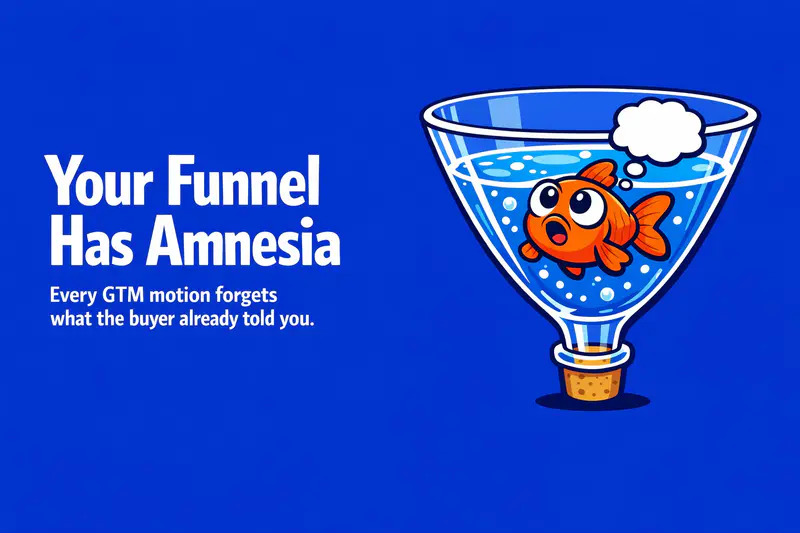
Every GTM motion forgets what the customer already told you. The forgetting happens at the handoffs from marketing to sales, trial to rep, rep to onboarding and chat to phone.
Each team does its job and each system keeps its own record. The customer has to start again.
In software that costs conversions. In high-consideration markets it costs far more, whether it is a borrower who explained their income twice, a patient who repeated their symptoms to a third person or a car buyer whose trade-in quote vanished between the website and the showroom.
Even buyers who choose self-service pay for the gap. Gartner's 2022 B2B buyer survey found buyers who completed a purchase through self-service were 1.65 times more likely to regret it.
Context-Led Growth exists to name that problem. In one sentence:
Context-Led Growth is a growth model in which each customer's context drives acquisition, conversion and retention: the complete picture of everything they have said, asked about, interacted with and been promised, carried across every team, channel and system so no signal of intent is lost between conversations.
Context-Led Growth doesn't replace your motion. It runs under it, so a product-led company still lets the product lead and a sales-led company still sends the rep. What changes is that every step starts where the last one ended.
The enemy has a name, funnel amnesia. So does the measure, leakage rate, the share of customer intent lost between stages.
How do you choose a GTM motion?
Choose a GTM motion by the buyer, not by fashion. Find the row that sounds most like the people you sell to.
| If your buyer... | Lean towards | Watch for |
|---|---|---|
| Can reach value alone in minutes | Product-led growth | The moment usage needs a human |
| Signs a large contract with a committee | Sales-led growth | Cost per deal and slow handoffs |
| Searches and researches before talking to anyone | Marketing-led growth | Leads that go cold after the form |
| Already buys through partners or platforms | Partner- or ecosystem-led growth | Context that stays with the partner |
| Takes a big personal risk, over weeks, across many channels | Any of the above, run context-led | Every handoff between channel and team |
The last row covers most of lending, insurance, healthcare and car buying. Those buyers ask the same question three ways before they commit, on WhatsApp, on a call and in person. A motion chosen for software assumes they ask it once.
Pick the motion for the buyer. Then make sure it remembers them.
The newest row is the oldest problem
Every growth model on this list was a fair answer to its moment. Field sales fit buyers who needed a guide, inbound fit buyers who searched, and product-led fit software easy enough to try.
Agent-led growth fits software that acts on its own. The question that never changed is the one buyers keep asking at every handoff. Do you remember what I told you?
If you want to know how your own motion answers it, read Dikshant Dave's Context-Led Growth essay, built from Zigment's work on AI agents, and take its eight-statement self-assessment.