
TL;DR
- An omnichannel experience is one continuous relationship that a customer carries across any channel, with the business remembering, deciding and promising the same thing on each one.
- Adding channels is the easy part. Customers judge the seams between channels, where context, consent and quotes tend to drop.
- Five traits define the real thing: one identity, one memory, one decision-maker, the customer's choice of channel and one set of promises.
- In banking, healthcare and automotive the seams carry regulated facts, so a broken seam costs paperwork, delays and compliance risk.
- The Seam Test audits each handoff in a journey from the customer's side, in six ordered steps.
9:40 pm. A home-loan applicant asks the bank's web chat whether a co-applicant's income can count toward eligibility. The chat says yes and asks for two payslips.
At 10:15 the next morning the applicant calls the branch. The branch asks for the loan amount, the co-applicant's name and the payslips.
From the start.
An omnichannel experience is a customer relationship that continues across every channel a business offers, so a customer can start on chat, carry on by phone and finish in person without repeating anything. The business recognises the same person, remembers what was said, decides the next step from the full history and keeps the same promises on every channel.
The bank in that scene had every word of the chat. It kept them where the branch could not read them.
This guide sets out the five traits that separate a true omnichannel experience from a business that is simply present on many channels. It shows each trait in banking, healthcare and automotive, then ends with the Seam Test, a step-by-step way to audit your own journeys.
What is an omnichannel experience, measured from the customer's side?
An omnichannel experience is judged by the customer at the moment they change channel. If the next channel already knows who they are, what they asked and what was agreed, the experience is omnichannel. If it starts from zero, the customer is dealing with a set of separate channels that share a logo.
Most businesses measure from the other end. They count the channels they run, such as web chat, WhatsApp, SMS, email, voice, an app, a branch, a clinic desk or a showroom.
Call it The Channel Mirage. From inside the company, eight channels look like coverage. From outside, they look like eight front doors, each with a receptionist who has never met you.
The Mirage is easy to build because each channel can be bought, launched and reported on by its own team. Continuity has no single owner, so it rarely gets built at all.
That gap is the practical line between multichannel and omnichannel. A multichannel business is reachable everywhere. An omnichannel business is continuous everywhere.
Customers never see your channel list. They only see the seams.
Why do most omnichannel setups still feel broken to customers?
Most omnichannel setups feel broken because information stays in the channel where it was captured. Each tool keeps its own transcript, its own contact record and its own rules for what happens next.
The customer pays for that design. Call it The Restart Tax, the time and patience a customer spends re-explaining a situation the business has already heard.
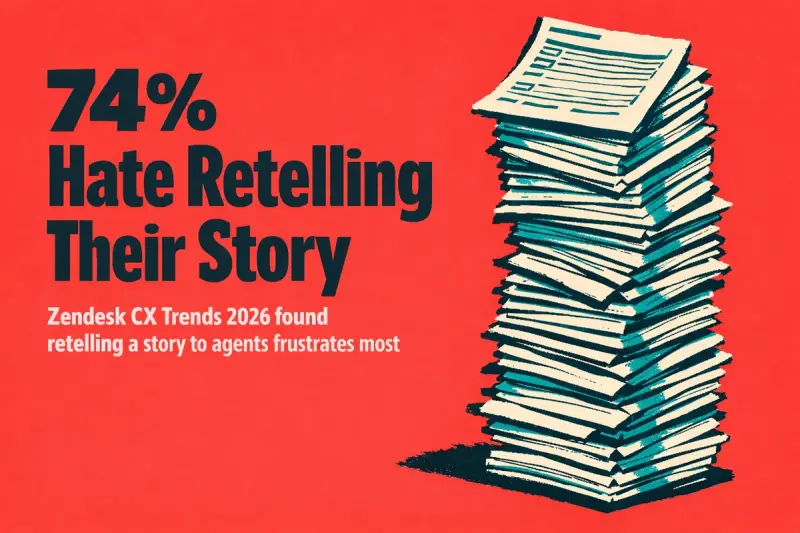
The tax is widespread. In the Zendesk CX Trends 2026 report, the vendor's own survey, 74% of consumers said it is frustrating to tell their story over and over to different agents.
Journeys also rarely stay in one place. A Gartner survey of 5,801 customers, run in January and February 2025, found that only 22% start, stay and resolve their issue entirely in a company's own channels.
So switching is the normal path, and every switch is a seam where context can drop. Three things usually break at a seam.
- Identity. The new channel creates a fresh contact because the phone number, email address or device does not match the old one.
- Context. The new channel cannot read the earlier conversation, so it asks the same questions again.
- Ownership. Two systems both believe they own the customer, and both send the next message.
Every seam charges the Restart Tax. The customer decides how many times they will pay it.
What are the five traits of a true omnichannel experience?
A true omnichannel experience shows five traits at the same time. Missing any one of them reopens a seam, so treat the five as a checklist rather than a menu.
1. One identity across every channel
The customer is recognised as the same person whether they message, call, email or walk in. Phone numbers, email addresses, account IDs and device signals resolve to one record, and a new channel attaches to that record instead of opening another.
This is the trait most teams assume they already have. A quick check is to count how many duplicate contacts your CRM created last quarter from people who simply changed channel.
2. One memory of every conversation
Everything the customer has said, sent and agreed is available to the next channel, in order. The memory includes the unstructured parts, such as the question asked at 9:40 pm, the document sent as a photo and the preference mentioned in passing.
A CRM field that reads "status: contacted" is a label. A memory is the conversation itself, with the commitments still inside it.
3. One decision-maker for the next move
A single orchestration layer decides what happens next, using the whole history. Without one, the email tool, the SMS tool and the messaging app each run their own sequence, and the customer gets three nudges in an hour about a form they finished yesterday.
One decision-maker also means one stop rule. When the customer completes a step, every channel goes quiet together.
4. The customer chooses the channel
The customer picks where to continue, and the business follows. Some steps suit a screen and some suit a conversation in person, and the mix changes from one customer to the next.
Car buyers show the pattern clearly. In the Cox Automotive 2025 Car Buyer Journey Study of 2,300 recent buyers, surveyed in fall 2025, 63% said a mix of online and in-person steps would be ideal.
Only 7% bought a vehicle completely online, according to the same Cox Automotive research. The experience has to survive the trip between the screen and the showroom.
5. One set of promises
A quote, a consent, an appointment time or a policy answer given on one channel holds on every other channel. If web chat confirmed an eligibility rule, the branch honours it, and if a patient opted out of SMS reminders by email, no SMS goes out.
In regulated industries this trait carries compliance weight. A consent captured on one channel and ignored on another is a governance failure as well as a poor experience.
Identity, memory, decision, choice and promise. Lose one and the customer feels the seam.
What does a true omnichannel experience look like in banking, healthcare and automotive?
Regulated industries make the five traits concrete, because the facts crossing each seam are documents, consents and quotes. Here is how each one plays out when every trait is in place.
Banking: the loan application that never restarts
Go back to the home-loan applicant. In a true omnichannel experience, the branch call opens with the chat already read: co-applicant income confirmed as eligible, two payslips requested, one received overnight as a photo.
The branch asks for the one missing payslip and books the property valuation. The applicant hears their own words played back, and the application moves forward from where it stopped.
Healthcare: the insurance card sent once
Insurance details are a common seam in healthcare. In the Experian Health 2026 State of Patient Access survey, vendor research covering more than 1,000 patients, 28% said insurance verification issues had delayed their care.
The Old Way: A patient books a specialist visit on the web, sends a photo of an insurance card by WhatsApp when asked, then calls to move the slot. The call center asks for the policy number again, and verification restarts a day later.
The Better Way: The call opens on the booking, the card photo and the verification already in progress. The new slot is offered only on days when verification will be complete, and the confirmation goes out on the channel the patient used last.
Same patient. Same clinic. One version remembers.
Automotive: the price agreed online
Car buyers want to do more online than they actually do. The Cox Automotive study found that 37% of buyers want to finalize the price online, while only 19% do.
Part of that gap is a seam. A price agreed in a web chat on Tuesday has to be the price the showroom quotes on Saturday, with the trade-in photos and the finance pre-check already attached to the same customer.
In regulated journeys the seam carries the facts. Drop them and the customer redoes the paperwork.
How do you run the Seam Test on your own journeys?
The Seam Test audits an omnichannel experience from the customer's side, one handoff at a time. Pick one revenue journey, such as an application, a booking or a test drive, and work through these steps in order.
- List every channel in the journey. Include the phone line, the in-person desk and the shared inbox your team replies from.
- Mark every seam. A seam is any point where a customer can move from one channel to another.
- Cross each seam as a test customer. Start on one channel, continue on the next a day later and write down every question you are asked twice.
- Check identity. Did the second channel attach to the same record, or did it create a new contact?
- Check the decision. After you finished a step, did every channel stop sending reminders about it?
- Check the promises. Did a quote, consent or appointment given on the first channel hold on the second?
Then score each seam against the table below. Each row is a handoff that fails often enough to test first.
| Seam | What breaks in a channel-by-channel setup | What a true omnichannel experience does |
|---|---|---|
| Web chat to phone | The agent asks the customer to repeat the request | The call opens with the chat history and the open question |
| Messaging app to email | Documents sent as photos never reach the case | Every attachment lands on the same customer record |
| Online to branch, clinic or showroom | Staff restart the application, booking or quote | The in-person step picks up from the last online step |
| Campaign to service | Promotions keep firing after a complaint | One decision layer pauses outreach until the issue closes |
| Any channel to an opt-out | Consent is recorded in one tool only | The opt-out applies on every channel at once |
If you were asked the same question twice, you found a seam.
Where does Zigment fit in an omnichannel experience?
Zigment is a Conversational Revenue Orchestration Platform for GTM teams, and it sits on top of HubSpot and Salesforce. It runs customer conversations through AI agents on WhatsApp, voice, SMS, email and web chat, and it supplies the two traits channel tools leave open, one memory and one decision-maker.
The memory is the Conversation Graph, a timeline of every conversation each customer has had with you, across every channel. Before an agent replies or acts, it reads that timeline, so the branch call knows about the 9:40 pm chat and the clinic knows the insurance card already arrived.
The agents act on their own inside boundaries your team configures once, such as consent rules, quiet hours and approval limits. They write every outcome back to HubSpot or Salesforce, stop outreach on every channel when a step is done, and pass a case to your staff as one orchestrated step when a rule calls for it.
Identity, choice and promises follow from the same design. When one record, one timeline and one decision layer sit behind every channel, a quote or a consent given anywhere is visible everywhere.
Cross one seam before your customers do
Your channels are probably all live, staffed and reporting healthy numbers. The open question is what happens between them.
Tonight, start a conversation on one of your channels and finish it on another tomorrow morning. How many times will your business ask you something you already said?
See how the Conversation Graph keeps one memory across every channel.